
England 1–2 Argentina: Why England Abandoned a Working Plan
England did not lose because they attacked too much. They lost after removing almost every reason Argentina had to defend. A piece from the notebook about a decision, and about the gap between having the information and acting on it — where data advises, the head coach decides, and the failure is one of interpretation, communication or authority rather than measurement.

Executive assessment
England’s defeat was not simply caused by Argentina improving or Lionel Messi producing two decisive moments. The match changed because England deliberately removed the structure that had made them competitive.
For roughly an hour, England had:
- disrupted Argentina’s midfield;
- limited Messi’s central influence;
- competed physically;
- retained enough attacking threat to prevent Argentina committing everyone forward;
- taken the lead through Anthony Gordon.
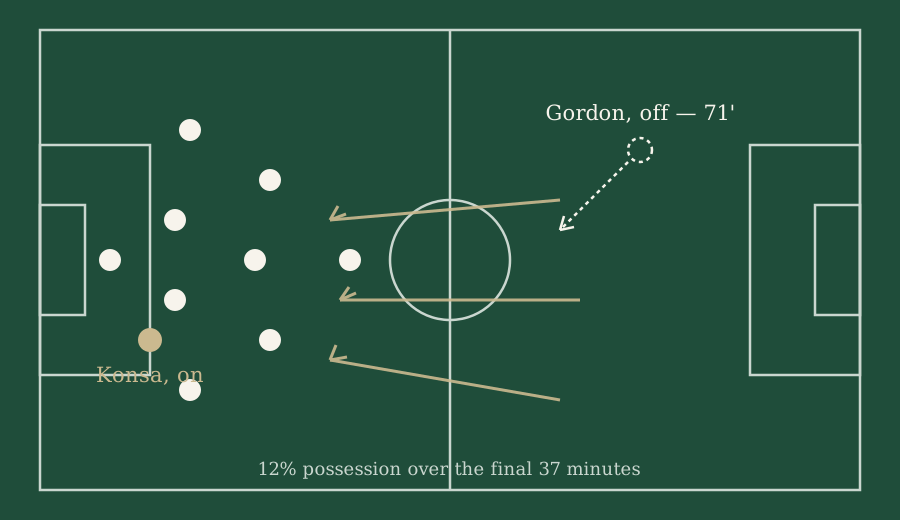
England then replaced Gordon with Ezri Konsa, adopted a more defensive shape and progressively removed their capacity to counterattack, retain possession or contest territory.
The decision was especially difficult to understand because the match had already demonstrated that passive defending against Argentina would be dangerous. Argentina were beginning to apply pressure before the substitution, but that should have created a need for fresh pace and better ball retention — not the removal of England’s clearest outlet.
The available evidence indicates that the change was tactical rather than forced by a publicly disclosed injury. Thomas Tuchel said he did not feel an attacking substitution would help. That judgement appears to have been the central error. (reuters.com)
The deeper question is why England proceeded when their own live analysis would probably have shown that territorial control, possession retention and successful defensive exits were already deteriorating.
The likely failure was not a lack of information. It was a failure of interpretation, communication or authority.
1. The match before England took the lead
The first half was physical, fragmented and closely balanced. The teams combined for nineteen fouls, two yellow cards and no shots on target.
England’s Elliot Anderson repeatedly pressured Messi, while Argentina struggled to establish sustained attacking rhythm. England were not dominating the ball, but they were preventing Argentina from controlling the match. (apnews.com)
This matters because England’s eventual retreat was not inevitable. The starting system had demonstrated that England could compete with Argentina without placing six defensive players across their own penalty area.
England’s defensive security came from several connected elements: Anderson applying pressure around Messi; Rice covering central spaces; Gordon and Rogers providing wide running; Kane and the attacking midfielders offering targets when possession was recovered; and Argentina having to protect the space behind their own defence.
The game was difficult, but it was stable. England were defending through a combination of pressure, midfield competition, positioning and counterattacking threat. They were not relying solely on the number of defenders positioned close to their own goal.
2. Gordon’s goal confirmed the value of England’s attacking structure
England scored in the 55th minute through a move that illustrated precisely what their later substitutions removed. Declan Rice initiated the attack, Morgan Rogers crossed and Gordon arrived to finish. (apnews.com)
The goal demonstrated three things: that England could progress quickly when they regained possession; that Argentina’s defence could be exposed by movement across and behind its back line; and that Gordon’s pace and positioning forced Argentina to defend their own goal rather than operate entirely in England’s half.
Gordon’s importance was therefore not restricted to scoring. His presence created a continuing tactical constraint. Even when Gordon did not receive the ball, Argentina had to consider his acceleration into the channel, his ability to attack the far post, his willingness to carry the ball over distance, and the possibility of England scoring a second goal on transition. That threat was part of England’s defence.
A fast attacker positioned high can prevent an opponent from committing an extra full-back, midfielder or centre-back into sustained attacks. Removing that attacker does not merely reduce offensive output. It changes how aggressively the opposition can play.
3. Argentina’s pressure was increasing
Argentina did begin to improve after falling behind. Nicolás González replaced Leandro Paredes in the 64th minute, increasing Argentina’s attacking presence. Pickford then made an important save from González shortly before the hydration break. (apnews.com)
This was the moment requiring a managerial response. There were several plausible options: introduce a fresh winger; replace a tiring attacker with Saka; refresh central midfield; instruct the defensive line to remain higher; retain Gordon but reduce his defensive workload; or maintain a back four while improving protection in front of it.
Instead, England treated Argentina’s rising pressure primarily as a penalty-box defending problem. That diagnosis led to Gordon being replaced by Konsa around the 71st or 72nd minute. England moved towards a back five and surrendered their most direct attacking outlet. Sky’s tactical analysis identified this as the hinge of the match. (skysports.com)
4. Why the Gordon-to-Konsa change was so damaging
The substitution affected every phase of England’s play.
England lost depth
Without Gordon, Argentina’s defenders could push closer to the halfway line. They had less reason to protect the space behind them.
England lost an outlet
Clearances no longer had a realistic destination. Possession was returned immediately to Argentina.
England lost ball-carrying
Gordon was one of the few England players capable of turning a defensive recovery into thirty or forty metres of territorial relief.
England lost psychological leverage
Argentina could see that England had removed a goalscorer and introduced another defender. Whatever Tuchel’s verbal instructions were, the personnel change communicated that England’s priority was survival.
England isolated the remaining attackers
Sky reported that Rogers managed only one touch between the change of shape and Martínez’s winner. (skysports.com) This is a crucial statistic. Rogers did not suddenly lose his technical ability. England’s structure stopped connecting with him.
The substitution did not merely make England more defensive. It disconnected the front of the team from the rest of it.
5. The possession collapse
From Gordon’s goal until Martínez’s stoppage-time winner, England reportedly had only 12% possession over approximately thirty-seven minutes. (reuters.com) A narrower measurement after Gordon’s withdrawal reportedly placed England’s possession at only 7.2%.
Possession alone does not prove tactical failure. Teams can defend successfully with little of the ball. But successful low-possession teams normally retain some capacity to counterattack, win fouls upfield, carry the ball into the opposing half, create throw-ins and corners, complete short periods of controlled possession, and make the opponent retreat. England did almost none of those things.
Their possessions became extremely short: recovery, then a clearance or rushed pass, then an Argentina regain, then a new Argentina attack. That cycle produces several consequences — defenders receive no physical recovery; midfielders must repeatedly run towards their own goal; the opponent can sustain positional pressure; clearances become less controlled; closing down outside the box becomes slower; concentration deteriorates; and attackers become spectators.
The possession split was therefore not just a stylistic difference. It was evidence of a system that had stopped producing exits.
6. More defenders did not mean better defending
The central tactical misconception was equating defensive personnel with defensive control.
Adding centre-backs can help with aerial duels, defending conventional crosses, protecting the six-yard box and blocking shots. But extra defenders can make a team less secure when they cause the midfield to become outnumbered, the defensive line to retreat too close to goal, opponents to receive the ball unpressured outside the area, clearances to be recovered immediately, and attacking outlets to disappear.
England increased the number of defensive players while reducing the number of mechanisms that prevent attacks. This created a crowded but passive defensive structure. Argentina were not required to break through England once. They were allowed to attack repeatedly until a chance or error appeared.
The distinction is between defending the penalty area and defending the match. England increasingly did the first while abandoning the second.
7. Messi’s movement exposed the flaw
England had largely restricted Messi for the opening hour. Anderson pressured him centrally and England closed the spaces around him. (reuters.com)
Messi then moved towards Argentina’s right. From there he could receive with less immediate pressure, face England’s defensive block, deliver crosses, combine around the edge of the area, and influence the game without needing to dribble through a crowded centre. England’s deeper shape made this role easier for him.
Reuters recorded that Messi began delivering dangerous crosses from the right. González forced a save from Pickford, and Alexis Mac Allister hit the post with a header. England’s defence was already scrambling before the equaliser. (reuters.com)
The warning was visible. England did not respond by restoring an attacking outlet or applying more pressure to Messi. They continued to add defensive personnel.
8. The 82nd-minute substitutions intensified the problem
Argentina introduced Lautaro Martínez for defender Nicolás Tagliafico in the 81st minute. England then replaced Reece James with Dan Burn and Declan Rice with Nico O’Reilly. Three minutes later, Enzo Fernández equalised. (apnews.com)
The contrast between the two benches was stark. Argentina removed a defender and introduced a striker; England removed a midfielder and a full-back and added more defensive weight. Argentina increased the number of players capable of deciding the game; England increased the number of players occupying defensive spaces. The result was a team with many defenders but reduced ability to pressure the ball.
9. The equaliser
Argentina’s equaliser came from Enzo Fernández outside the penalty area. Messi received the ball on the right following a short corner and supplied Fernández, who struck in the 85th minute. (apnews.com)
This goal exposed the weakness of simply packing the penalty box. England had bodies close to goal, but insufficient pressure on the player shooting from the edge of the area. Reuters reported that a fatigued Jude Bellingham failed to close Fernández down. (reuters.com)
That fatigue was not independent of the tactical plan. Sustained defending without possession exhausts midfielders. England’s shape demanded repeated defensive movements while offering almost no opportunity to rest with the ball. A deeper defensive structure can protect space behind the defence but surrender space in front of it. Fernández exploited exactly that area.
10. The winning goal
Martínez scored in the second minute of stoppage time after another Messi delivery from the right. (apnews.com) England had added defenders partly to protect the penalty area, yet the decisive substitute was still able to find space for a close-range header.
This does not mean the defenders lacked numbers. It means numbers alone were insufficient after prolonged pressure had disrupted concentration, marking assignments, communication, midfield protection and control of the crossing player. England had chosen to defend repeated crosses. Eventually one found the decisive target.
11. Tuchel’s explanation
Tuchel said he had no feeling that an offensive substitution would help. He also said England remained in a 4-4-2 but became passive, conceded chances and could not shift possession in their favour. (reuters.com)
This explanation raises more questions than it answers. If England’s problem was passivity and inability to retain possession, an attacking or possession-oriented substitute would appear more — not less — relevant.
If the formal formation remained 4-4-2, the practical question is not what formation was written on the tactical board. It is: where were England defending; who could receive the first pass after a regain; who threatened the space behind Argentina; how high could England’s block remain; and how frequently could England enter Argentina’s half? The observed answers were extremely negative. A nominal 4-4-2 can function like a back six when the wide midfielders become auxiliary full-backs and the forwards are isolated.
12. Why might Tuchel have made the decision?
Several explanations are plausible.
12.1 He expected Argentina to attack through crosses
Messi had moved wide, González had become a threat and Argentina were increasing their penalty-area presence. Tuchel may have concluded that England needed more aerial strength, an extra centre-back, greater protection around the posts and better numbers against crosses. This reasoning was understandable but incomplete. It addressed the final action without addressing why Argentina were being allowed endless opportunities to deliver it.
12.2 He believed Gordon could no longer contribute physically
Gordon may have been tired, despite no public evidence that he was injured or unable to continue. But even if Gordon needed to leave, England could have replaced him with another runner, particularly Saka. Removing Gordon was not necessarily the decisive error. Removing his tactical function was.
12.3 He trusted defensive specialists
Coaches often believe that specialist defenders are the safest players to introduce when protecting a lead. This can create a false sense of security. The substitution is visibly cautious, but its indirect effects may increase danger.
12.4 He feared losing the match through an aggressive decision
Managers are often judged more harshly for conceding after making an attacking substitution than for conceding after adding defenders. This creates a bias towards conventional caution. Had Tuchel introduced Saka and England conceded, critics might have said he failed to protect the lead. Adding defenders appears defensible before the outcome is known. But good decision-making should be based on probabilities, not on which failure is easiest to explain afterwards.
12.5 He misread Argentina’s problem
Argentina’s difficulty for the first hour was not simply England having enough defenders. It was England’s ability to disrupt, compete and threaten transitions. By withdrawing Gordon, England helped solve one of Argentina’s main problems.
12.6 He overestimated England’s ability to defend passively
Tuchel may have believed England could absorb twenty minutes of pressure with a back five. That might have been reasonable against a weaker opponent or a team without elite creators. Against Argentina, with Messi moving freely and multiple attacking substitutes available, the margin for error was extremely small.
12.7 He underestimated the psychological message
Substitutions affect behaviour as well as shape. Replacing the goalscorer with a centre-back can tell players to retreat, protect, avoid risk, clear the ball and prioritise defensive positions. Even when the manager verbally says “keep attacking,” the personnel may communicate the opposite.
13. What the live data probably indicated
England’s analysts would almost certainly have been monitoring some combination of possession over recent intervals, territory and field tilt, entries into the defensive third, penalty-area touches, recoveries after clearances, pressure on the ball, player running output, passing sequences after regains, expected-goal accumulation and win probability. The precise internal data is not public.
However, the visible match data would likely have shown Argentina’s territorial dominance rising, England’s possession sequences shortening, England’s exits becoming less frequent, pressure accumulating around the box, Gordon’s removal reducing transition threat, and England’s attacking players becoming disconnected.
A model may not issue a direct instruction such as “bring on Saka.” But it would likely identify the game state as unstable. The sensible data-led responses would have included restoring pace, strengthening midfield control, moving the block higher, improving possession after recoveries, and reducing the frequency of Argentina’s attacks. England instead continued moving in the opposite direction.
14. Why would England make the change if their own data was warning against it?
This is the most difficult part of the decision to explain. England’s analysts were almost certainly seeing the same deterioration that was visible externally: Argentina’s possession rising sharply; England completing fewer passes after regaining the ball; defensive recoveries being returned immediately to Argentina; England’s territorial position moving steadily backwards; Gordon remaining the clearest threat behind Argentina’s defensive line; England’s forwards becoming increasingly isolated; and Argentina producing more penalty-area entries and dangerous deliveries.
A modern performance department would not need to wait for the 88% possession figure to become established. Five- and ten-minute rolling data would have shown the direction of travel much earlier. The likely answer is not that England lacked the information. It is that the information did not determine the decision.
Data advises; the head coach decides
Analysts can show that pressure is increasing, exits are declining and the team’s attacking threat is disappearing. They cannot normally order a substitution. The coaching staff must interpret the information. The same data can produce different conclusions. Interpretation one: England need pace and possession to relieve pressure. Interpretation two: Argentina are becoming dangerous, so England need another defender. Tuchel appears to have selected the second interpretation. The data may have described the problem accurately while the coaching staff chose the wrong remedy.
The analysts may not have modelled the substitution itself
England may have had live figures for possession, field position, physical load, defensive actions, chance quality and passing sequences. That does not necessarily mean they had a reliable model calculating the specific effect of replacing Gordon with Konsa. A live dashboard might show Argentina pressure increasing, Gordon’s sprint output declining, England losing aerial duels and more crosses entering the box. A coach could examine those figures and conclude that an additional centre-back was necessary. The missing calculation may have been the indirect cost: removing England’s transition outlet, allowing Argentina’s line to advance, reducing the value of clearances, isolating Kane and Rogers, and increasing the frequency of Argentina’s attacks. The most important consequence of the substitution was not a simple individual metric. It was the interaction between team shape, territory and opposition behaviour.
Fitness data may have outweighed tactical data
England may have possessed private physical information suggesting Gordon was tiring — total distance, high-speed running, repeated sprint capacity, acceleration decline, heart-rate information, medical feedback, subjective reports from the player. If Gordon’s physical output had fallen significantly, the staff may have decided he could no longer perform his pressing and transition role. But this still does not fully explain the choice. If Gordon needed to leave, England could have preserved the role by introducing Saka or another quick attacker. The unresolved issue is not only why Gordon was withdrawn. It is why England replaced an attacking outlet with a defender when their existing difficulty was escaping pressure.
Coaches often prioritise the most visible danger
The immediate visible danger was Argentina crossing, shooting and entering the penalty area. The less visible danger was England losing every mechanism for preventing the next attack. Adding a centre-back addresses the visible problem: another body in the box, more aerial strength, more blocking ability, greater numerical cover. Keeping Gordon, or replacing him with another winger, addresses an indirect problem: forcing Argentina backwards, creating uncertainty, winning territory, allowing England to rest with the ball. Under pressure, coaches can favour the intervention that looks most obviously defensive, even when the indirect solution offers greater protection.
The decision may have been influenced by loss aversion
England were leading a World Cup semi-final. At that point, the psychological objective can change from winning the match to avoiding responsibility for losing it. An attacking substitution carries a visible risk. If England introduced Saka, continued attacking and conceded, the manager could be accused of failing to protect the lead. Introducing a centre-back appears cautious and conventional. If the team then concedes, the decision can be defended as an attempt to withstand pressure. This creates a managerial bias: attacking failure looks reckless; defensive failure looks unfortunate. That bias can encourage coaches to choose the decision that is easier to justify rather than the one with the highest probability of success.
The staff may have trusted defensive structure more than live momentum
Tuchel’s background is strongly associated with detailed positional structures and tactical adjustments. He may have believed that changing the defensive shape would restore control even if possession remained low. The assumption may have been: add Konsa, close the spaces around Messi, defend crosses with greater numbers, survive the next phase, and use Kane or Rogers to hold occasional clearances. The problem was that the last two steps never became realistic. England did not regain enough possession to reset the shape, and the remaining forwards received almost no service. The plan may have made sense on a tactical board but failed under the actual speed and pressure of the match.
The substitution may have sent a stronger message than the instructions
Kane later indicated that England were still being told to attack. But players interpret personnel decisions as well as verbal instructions. When the goalscorer and main running threat is replaced by a centre-back, the practical message is: protect the lead, retreat, avoid losing shape, clear danger, prioritise defensive positions. Even if Tuchel instructed England to remain aggressive, the substitution changed the incentives and reference points available to the players. A team cannot easily attack in the same way after removing one of the players who makes that attack possible.
Information may not have reached Tuchel quickly or forcefully enough
International teams have analysts feeding information to the bench, but there are still human and organisational limitations. Possible failures include analysts reporting numbers without making a clear recommendation; coaching staff focusing on selected metrics; information arriving after the substitution had already been prepared; confirmation bias causing staff to interpret data in support of the defensive plan; analysts having insufficient authority to challenge the head coach; and the bench believing the pressure would naturally decline after the shape change. The key organisational question is therefore not merely whether England possessed the data. It is whether the structure around the manager allowed someone to say: the change has made the situation worse, and we need to reverse it immediately. The continued defensive substitutions suggest either that this warning was not delivered, was not accepted or was outweighed by Tuchel’s judgement.
The data may have been correct but backward-looking
Live football data describes what has happened. Coaches must decide what happens next. England’s analysts could show that Argentina had taken control, but Tuchel may have believed the additional defender would change that trend, that Argentina would tire, that the match would become more direct, that England could defend the final phase, and that the value of extra height would emerge late. This would represent a forecast that the existing data trend was about to reverse. It did not. Instead, the substitution intensified the trend the data was already identifying.
Why the later substitutions are harder to defend
The first defensive change can at least be explained as an attempt to respond to increasing pressure. The later decisions are more problematic because England had additional evidence by then. After Gordon left, England’s possession collapsed further, Argentina maintained continuous pressure, England’s attackers became disconnected, Pickford was repeatedly involved, and Argentina continued creating dangerous situations. At that point, the original intervention was visibly failing.
A data-responsive bench should have considered reversing course: introduce Saka, move a player higher, restore midfield numbers, create an outlet, stop allowing Argentina to restart attacks immediately. Instead, England added further defensive weight. That suggests the staff had committed to a theory of the match and continued supporting it despite contrary evidence.
The most plausible overall explanation
The most likely sequence is this. England took the lead. Argentina increased pressure. Gordon’s physical condition may have begun to decline. Tuchel identified crosses and penalty-area entries as the immediate danger. He chose an additional defender to strengthen the box. The change removed England’s main outlet. England’s possession and territory collapsed. The bench interpreted the resulting pressure as evidence that still more defensive protection was needed.
The original mistake therefore produced the conditions used to justify the later mistakes. This is a tactical feedback loop. The more England defended, the more pressure they faced. The more pressure they faced, the more defensive they became. The internal data may have been warning that the strategy was unstable, but the coaching response treated the consequences of the strategy as reasons to continue it.
The central institutional question
The defeat raises a broader question about how England use analysis. Having sophisticated data is not enough. The value of analysis depends on whether the right metrics are monitored, whether indirect tactical effects are understood, whether analysts can make clear recommendations, whether coaches are willing to change their view, and whether the organisation can challenge a high-status decision-maker during a match.
England likely had enough information to know they were losing control. The failure was probably not one of measurement. It was a failure of interpretation, communication or authority. The data may have been saying: England need a way out. The coaching decision said: England need another defender. That distinction may have decided the match.
15. What England should probably have done
If Gordon was physically capable of continuing, England could have kept him on, preserved the back four, used a fresh midfielder or winger elsewhere, told Gordon to remain available for transitions rather than press continuously, defended slightly higher, and forced Argentina to protect against the counterattack.
If Gordon needed to leave, England could have replaced him with Saka or another wide forward, preserved width and pace, maintained at least two credible transition outlets, avoided removing Rice unless physically necessary, and introduced a technically secure midfielder rather than another defender.
A controlled defensive substitution later in the match could still have been appropriate. The problem was the timing and cumulative direction of the changes. England began protecting the lead with more than twenty minutes remaining against the defending world champions. They then reinforced the same failing approach even as the evidence showed it was not working.
16. Could England still have lost with Gordon on?
Yes. Argentina had improved. Messi was capable of producing decisive moments, and England’s players were tiring. Keeping Gordon on would not guarantee victory.
The relevant question is whether England’s chosen strategy improved or reduced their probability of reaching the final. The available evidence strongly suggests it reduced it. Gordon’s presence would probably have lowered Argentina’s defensive line, reduced the number of players committed forward, given England a target after recoveries, created occasional counterattacks, provided short periods of territorial relief, and made sustained 88% Argentina possession less likely.
Argentina might still have equalised. But the match would probably have remained more balanced, and England would have had a better chance of scoring again or reaching extra time.
17. Final judgement
The Gordon-to-Konsa substitution was not an isolated mistake. It was the first move in a sequence that removed England’s ability to influence the match outside their own defensive third. The decision appears to have been based on a familiar but flawed assumption: that when protecting a lead, adding defenders makes the team safer. In this match, the opposite occurred.
England became deeper, more passive, less capable of retaining possession, less threatening on transition, more physically exhausted, easier for Messi to control from the right, and increasingly vulnerable to repeated attacks.
The most troubling aspect is that the deterioration was visible before the equaliser. Pickford had already made an important save, Argentina had hit the post, England’s possession had collapsed and the attacking players were becoming isolated. Yet England did not reverse course.
The decision was understandable as an act of caution. It was difficult to justify as a response to the actual problems occurring on the pitch. England did not lose because they attacked too much. They lost after removing almost every reason Argentina had to defend.
The data probably identified the danger. The coaching staff appear to have interpreted that danger as justification for becoming even more defensive. That is the central failure: England possessed information showing that control was disappearing, but responded by removing more of the tools required to recover it.